'S
The April Newsletter is available
ESNA Demonstrates On-going Commitment
to
Interoperabilityand Open Standards
ESNA
Announces OSGP DLMS/COSEM Integration and Works with DVN KEMA for OSGP Certification
Amsterdam, The
Netherlands, October 4, 2012 – Energy Services Network Association (ESNA), an association composed
of utilities, developers, and integrators that promote open standards for the
smart grid, today announced two important initiatives to promote
interoperability and drive adoption of the Open Smart Grid Protocol (OSGP) as a
standard for smart meters and smart grid devices.
OSGP is a family of specifications published by the European Telecommunications
Standards Institute (ETSI). OSGP, ETSI GS OSG 001,
is a relatively new but widely used specification for smart meter and smart
grid devices, with over 3.5 million OSGP based smart meters and devices
deployed worldwide. OSGP is a very efficient data representation and
interchange protocol that delivers high effective throughput on narrowband
Power Line Communications (PLC) and other links. ESNA has partnered with Gurux, a leader in device communications protocols for the
smart grid, to provide utilities the ability to access OSGP-based smart meters
using the widely used DLMS/COSEM application data model using IEC 62056
parts 47, 53, 61, and 62. OSGP DLMS/COSEM interoperability provides utilities
the ability to choose a common data model for smart meters to lower IT
integration costs while benefiting from the proven efficiency, reliability, and
scalability of OSGP at the device networking layer for both smart meters and
other smart grid devices.
To further speed and promote the adoption of OSGP as an open standard,
ESNA has signed a Memorandum of Understanding with DNV KEMA Energy & Sustainability to offer OSGP
conformance and interoperability test services. Working together, ESNA and DNV KEMA provide a trusted source of
verification for utilities that vendors’ products interoperate and conform to
the OSGP specifications. The establishment of this cooperation provides vendors
third-party validation of their OSGP implementations that can complement their
internal test efforts.
ESNA will offer attendees
of Metering, Billing/CRM
Europe 2012 in Amsterdam, The Netherlands, which runs from
October 9-11, firsthand insight on how OSGP delivers a truly modern standard
for a modern grid. Demonstrations in the OSGP by ESNA booth D18 will include a
demonstration of interoperability of a DLMS/COSEM enterprise application with
OSGP based smart meters.
In addition, there is a
pre-conference seminar entitled “OSGP the Open Smart Grid
Protocol - a Flexible Solution to Reach Interoperability Between Systems and
Parties Connected to the Energy Infrastructure” on Monday, October 8th
from 13:00 to 15:30 CET. For more information, click here.
To provide technical, product and partner information on OSGP, ESNA has also launched a new website.
About Energy Services Network Association (ESNA)
ESNA is an independent global, not-for-profit association that promotes the
adoption of the Open Smart Grid Protocol (OSGP) and related services and
infrastructure for smart grid applications. Members include utilities,
software, hardware and service providers, and solution integrators that share a
common goal and vision for promoting open standards for energy demand side
management, smart grid and smart metering systems.
About DNV KEMA Energy & Sustainability
DNV KEMA Energy & Sustainability, with
more than 2,300 experts in over 30 countries around the world, is committed to
driving the global transition toward a safe, reliable, efficient, and clean
energy future. With a heritage of nearly 150 years, we specialize in providing world-class,
innovative solutions in the fields of business & technical consultancy,
testing, inspections & certification, risk management, and verification. As
an objective and impartial knowledge-based company, we advise and support
organizations along the energy value chain: producers, suppliers &
end-users of energy; equipment manufacturers; as well as government bodies,
corporations and non-governmental organizations. DNV KEMA Energy &
Sustainability is part of DNV, a global provider of services for managing risk
with more than 10,000 employees in over 100 countries. For more information on
DNV KEMA Energy & Sustainability, visit www.dnvkema.com.
About Open Smart Grid
Protocol (OSGP)
The Open Smart Grid Protocol (OSGP) is a family of specifications published by
the European Telecommunications Standards Institute (ETSI) used in conjunction
with the ISO/IEC 14908 control networking standard for smart grid applications.
OSGP is optimized to provide reliable and efficient delivery of command and
control information for smart meters, direct load control modules, solar
panels, gateways, and other smart grid devices. With over 3.5 million OSGP
based smart meters and devices deployed worldwide it is a widely used smart meter
and smart grid device networking standard. More information about OSGP can be
found at www.opensmartgridprotocol.org.
Harry
Crijns
Secretary
harry@esna.org

ESNA introduces OSGP at Metering Europe in Amsterdam
Metering Europe, the start of the OSGP Market introduction, therefore ESNA will be present to present the Open Smart Grid Protocol.
This year Metering Europe Exhibition will be in the RAI-exhibition centre in Amsterdam on the 9th - 11th of October.
In our booth, location D18, we exhibit our vision regarding the modernisation of the existing electricity distribution networks and the development of new value added Smart Grid applications.
Furthermore we show OSGP's unique place amongst the many different protocols used and the future interconnection due to the increase of hybrid usage of the Power Networks.
If you want to learn more about OSGP...welcome in our booth.
For a free ticket to visit the exhibition, please register here...

ESNA will organise an OSGP workshop in Amsterdam on October the 8th
ESNA - The Energy Services Network
Association is pleased to announce the OSGP workshop that will supply
information about the Open Smart Grid Protocol and share ESNA’s vision with
stakeholders involved in the modernization of existing power systems and the
development of new Smart Grid applications.
Worldwide there are already
millions of devices communicating with and controlled by the Open Smart Grid
Protocol. As many different protocols used in energy systems will be
interconnected in the future because of the increased hybrid use of the power
system, focusing on interoperability and information security is a must.
Other considerations include the growing use of distributed resources,
E-mobility and the application of distributed storage. These, as well as
interoperability, will be covered in this seminar together with the operational
functionality of OSGP.

Echelon receives Frost & Sullivan Growth Leadership Award
For the second year in a row, Echelon has been recognized with the Growth Leadership Award, Advanced Meter Infrastructure (AMI) Europe 2012 from Frost & Sullivan. Echelon was selected as the winner for its continual work in the following areas:
- Accelerated Growth in Business
- Targeting New Emerging Markets
- Technology Innovation and Development
- Development Plans for Future Roadmap
Leading Meter Manufacturers in Asia Adopt Echelon’s Control Operating System and the OSGP Standard
New Sub-System Offerings Enable Manufacturers to Rapidly, and Cost-Effectively Offer a Comprehensive Smart Grid Solution to Millions of Utility Customers
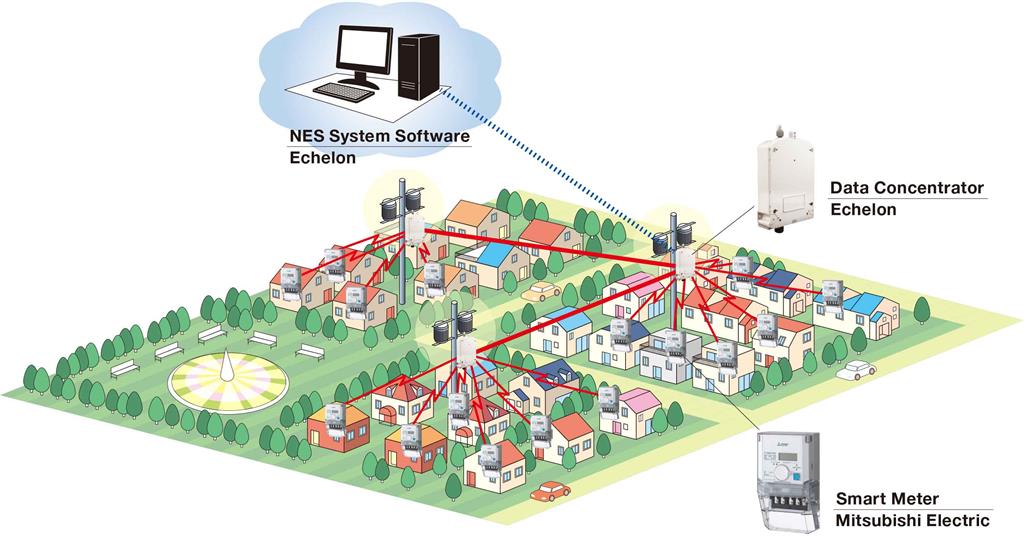
Echelon Corporation introduced a new Echelon Control Operating System (COS)-enabled control module that, when coupled with Echelon’s data concentrator and system software, enables electricity meter manufacturers to quickly and cost-effectively offer a comprehensive solution for automated metering and low voltage grid optimization. The new CPM 0600 control point module implements the Open Smart Grid Protocol (OSGP) and transforms the manufacturer’s electronic meter into a smart meter plus grid sensor that leverages Echelon’s proven, open standard, and multi-application energy control networking platform. The company also announced that leading meter makers in Asia, including Mitsubishi Electric Automation (Thailand) Co., Ltd., Korea’s VIDCOM, Malaysia's Comintel, and China’s Holley Metering, will offer solutions based on Echelon’s platform.
In addition to enabling these meter manufacturers to address their home markets with the latest technology, Echelon’s CPM 0600 also provides an opportunity to offer OSGP compatible meters to utilities in other markets that are looking for multiple sources of interoperable meters and grid devices. The new CPM 0600 for smart meters complements the Echelon CPM 6000, which transforms other devices, such as solar micro-inverters, load control modules, power quality sensors and electric vehicle chargers, into OSGP smart grid devices that seamlessly plug into Echelon’s three-tier energy control networking platform.
"Regional meter makers in Asia are a powerful force in their home markets, often having long standing relationships with the local utilities. Regional meter makers in several other emerging markets, such as Central and Eastern Europe, and the Middle East and Africa, also hold trusted partnerships with their utilities," said Bob Gohn, vice president at Pike Research, a leading market research firm focusing on global clean technology. Pike Research estimates that 162 million smart meters will be installed in these markets between 2012 and 2020.
"The OSGP-compliant module brings us the best of both worlds – we are able to produce our own smart meters based on the leading OSGP protocol, but we also get the benefits of plugging our meters into Echelon's leading end-to-end smart metering and grid optimization system," said Jun Young Lee, CEO of VIDCOM Co., Ltd., an innovative meter manufacturer headquartered in South Korea, serving utilities in South East Asia. "We see rapidly growing interest in smart metering systems across the countries we serve; and with the new OSGP module, we save years of effort and are able to enter the market immediately and compete aggressively with a market-leading system."
"Working closely with Echelon, we've already secured our first pilot with Tanaga Nasional Berhad Research, which is the leading utility in Malaysia serving more than eight million customers," said Lim Keng Hockat, CEO of Comintel Sdn Bhd, a leading system integrator for utilities in Malaysia and Indonesia. "The value of Echelon's sub-system offering with the CPM 0600 is real and has proven fruitful for us."
"Echelon gives us more than a control module. They allow our meters to plug into an end-to-end system that allows us to offer advanced metering capabilities," said Jin Meixing, chairman of Holley Metering, one of the top three metering companies in China. "The benefits of building upon OSGP will save us a tremendous amount of time in our smart meter development efforts and will quickly open up new opportunities for us in other markets where customers are seeking multiple OSGP meter vendors."
"A key component of our strategy is to extend the reach of our energy control networking platform by partnering with leading manufacturers in high-growth geographies," said Ron Sege, chairman and CEO of Echelon. "Building on the successes of our partnerships with ELO in Brazil and Holley Metering in China, the new OSGP-compliant module is the latest in a series of sub-systems designed to serve the needs of meter manufacturers in high-growth geographies and accelerate both their growth and ours, as utilities move to smart metering and grid systems."
About Echelon’s Energy Control Networking Platform
Echelon’s energy control networking platform is a three-tiered configuration of devices, control nodes, and enterprise software from Echelon and its partners that enables multiple energy management applications at the edge of the grid. Devices communicate using various device networking standards such as LonWorks®, Open Smart Grid Protocol (OSGP), Device Language Message Specification (DLMS™), Modbus® and others. Control nodes are responsible for running applications that act on the collected data locally, and for mapping these device protocols into the Web/IT domain so that enterprise applications can work on big data when required. Unlike data networking, control networking requires a semantic understanding of device control protocols across all tiers so that monitoring and decision-making can be distributed and decisions made at all three tiers as appropriate for maximum response time, reliability and resiliency. The software that runs across the tiers of the control networking platform to enable such distributed intelligence and control is Echelon’s Control Operating System (COS). Partners can plug into, customize or extend the energy control networking platform by integrating their devices and applications with COS.
About Open Smart Grid Protocol (OSGP)
Built on open ISO/IEC and IEEE standards, the Open Smart Grid Protocol (OSGP) is a device control networking protocol published by the European Telecommunications Standards Institute (ETSI) for smart grid applications. OSGP specifies a media independent control layer for secure and reliable communication between grid devices, such as meters and control nodes (e.g. data concentrators). OSGP enables independent implementation of interoperable meters and other smart grid devices from multiple vendors on the same network, and helps the utility lower cost and enhance functionality by enabling multiple smart device devices and applications to share a common infrastructure while avoiding vendor lock-in. Utilities can then concentrate on building applications that reduce peak loads, balance the grid, reduce losses, identify impending outages, etc. instead of focusing on just the meter and its connectivity protocol. The Energy Service Network Association (ESNA), a non-profit corporation composed of utilities, manufacturers, and integrators, is responsible for publishing, maintaining, and certifying devices compatible with the OSGP specification.

Echelon and Holley Metering to Create Joint Venture to Develop and Sell Innovative Smart Grid Solutions in China
New
Joint Venture Company Combines the Unique Capabilities of Silicon
Valley and China to Bring Feature-Rich, Cost-Effective Smart Grid
Solutions to a Broader Market
Echelon
Corporation, and Holley Metering Limited, a leading smart metering
vendor in China, today announced an agreement under which the two
companies will form a new joint venture company in China, Zhejiang
Echelon-Holley Technology Co., Ltd. ("Echelon-Holley"), to focus on the
development and sales of advanced smart metering products for China.
Echelon-Holley is committed to act in the best interests of the two
companies' respective customers and agents.
The
new company will be headquartered in Hangzhou, China, and will develop
advanced smart metering and related solutions that deliver performance,
reliability and expanded functionality to China’s developing smart grid.
The partnership will leverage Echelon's Silicon Valley energy control
networking innovation center and its 20 years of experience in highly
reliable power line control and communications hardware and software
platforms for smart grid applications, and Holley Metering's breadth of
metering solutions, low cost manufacturing competencies and extensive
customer relationships. The joint venture is majority owned by Echelon.
Echelon and Holley Metering will both contribute cash and resources into
the new company.
This
transaction represents a unique relationship between leading Chinese
and U.S. companies in the smart grid industry. Echelon and Holley
Metering can leverage their respective strengths through this
cooperation. The partnership will create significant value, not only for
the two companies involved, but also for the customers, distributors,
OEMs and other agents throughout China. This transaction is a highly
constructive development in the industry.
"We
are delighted to broaden our partnership with Holley Metering to serve
the larger smart grid market in China. With a mandate to connect 300
million homes and businesses to the smart grid over the next five years,
Chinese utilities will need to leverage the best the world has to
offer," said Ron Sege, chairman and CEO of Echelon. "Our new joint
venture is positioned to bring the most innovative solutions in the
world to bear on China's need to deliver and use energy more efficiently
by leveraging both Silicon Valley and China-based ingenuity. We are
also excited about the possibility of achieving Echelon and Holley
Metering’s broader vision for the joint venture’s future in developing
smart meter products for markets outside China."
"We
are extremely excited to utilize Echelon's field-proven technologies
and leverage their extensive experience gained by connecting more than
35 million homes and 300,000 buildings to the smart grid," said Jin
Meixing, chairman of Holley Metering. "By bringing the best technology
in the world into China and incorporating it into products that meet
this market's unique needs, we can grow our business and satisfy a
critical, unmet need."
The Echelon-Holley joint venture is expected to be operational in Q3 2012.
ETSI Approves Open Smart Grid Protocol (OSGP)
for Grid Technologies
Sophia Antipolis, France – January 18, 2012 – ETSI has recently published two specifications for Smart Grid that will help drive the development and deployment of open, interoperable smart grid technologies internationally.
As the smart grid evolves, it will become commonplace for utilities to cooperate with grid-aware systems and devices to reduce power usage intelligently, giving commercial, industrial and municipal users reduced rates in exchange for lower consumption while increasing grid reliability and the use of renewable energy sources. Automated demand response, peak load management, and other programs can mean significant cost savings for commercial and residential customers. This is why it is important that vendors work together through open standards to increase the market for compatible products and technologies. Standards-based smart grid devices and systems can monitor and save energy, lower costs, improve productivity, enhance service, quality, safety, and convenience, and help in the transformation to a more energy efficient future and smarter electricity grid.
The two OSGP specifications that originated with ESNA and were published by ETSI for global use are:
- Group specification GS OSG 001: Open Smart Grid Protocol. Produced by the ETSI Open Smart Grid Industry Specification Group, this application layer protocol can be used with multiple communication media.
- Technical specification TS 103 908: Powerline Telecommunications (PLT); BPSK Narrow Band Power Line Channel for Smart Metering Applications. This specification defines a high-performance narrow band powerline channel for control networking in the smart grid that can be used with multiple smart grid devices. It was produced by the ETSI Technical Committee for Powerline Telecommunications (TC PLT).
"As the effects of globalization permeate further and accelerate, ETSI is providing businesses and the industry with efficient solutions for accessing and developing new and established world markets via standardization," said Luis Jorge Romero, director general of ETSI.
"ESNA has been very active during the past year in the various Smart Metering and Smart Grid standardisation activities across Europe as well as the rest of the world. We are honoured to share this latest achievement with OSGP being recognized by ETSI, and we anticipate sharing more milestones reached with other leading standards organizations in the coming year," said Bo Danielsen, president of ESNA and head of smart grid projects at SEAS-NVE, the largest consumer-owned utility in Denmark.
"Industry's involvement in standards development is critical as standards contribute to innovation, enable interoperability, provide investment security to clients and contribute to fostering global markets, and moreover provide choice and investment security for our customers," said Bastian Fischer, VP Industry Strategy Utilities Global Business Unit at Oracle, ESNA board member and vice-chairman of the ETSI OSG Industry Specification Group. "Oracle is uniquely positioned to deliver mission-critical smart grid software applications that have been engineered to work together in collaboration with our partners. ESNA's success with ETSI will help ensure that Oracle and the smart grid ecosystem will provide reliable solutions to utilities that are complete, future proof, open, and cost-effective."
Notes for Editors
About ETSI
ETSI produces globally-applicable standards for Information and Communications Technologies (ICT), including fixed, mobile, radio, converged, aeronautical, broadband and internet technologies and is officially recognized by the European Union as a European Standards Organization. ETSI is an independent, not-for-profit association whose more than 700 member companies and organizations, drawn from 62 countries across 5 continents worldwide, determine its work programme and participate directly in its work. For more information please visit: www.etsi.org
About ESNA
Energy Services Network Association (ESNA) is an independent global, not-for-profit association under Dutch law. Members are utilities, software, hardware and service providers, and solution integrators sharing a common goal and vision for promoting open standards for energy demand side management, smart grid and smart metering systems. The association promotes the adoption of the Open Smart Grid Protocol (OSGP) and related services and infrastructure, based on Networked Energy Services (NES), together with the value-added applications for secure, reliable and cost-effective automatic meter management, smart grid management, billing, CRM, CIS and other applications.
More information about ESNA can be found at www.esna.org or by emailing secr@esna.org.
About OSGP
In 2010, ESNA members announced their intent to publish OSGP as an open standard, enabling independent implementation of interoperable meters and other smart grid devices from multiple vendors on the same network. Built on open ISO/IEC and IEEE standards, OSGP adds additional security and reliability services necessary to properly network and manage devices in the smart grid. The OSGP standard will ensure reliability, robustness, and efficiency of the smart grid, and as applications are deployed such as point-of-use monitoring and control of power usage, it will enable utilities to reduce peak loads and pass on energy cost savings to consumers. In addition to building OSGP-compliant solutions, utilities can better avoid vendor lock-in and purchase best-in-class products to achieve better ROI.
The ETSI logo is a Trade Mark of ETSI registered for the benefit of its Members.
For general ETSI press enquiries: Ultan Mulligan
Events & Communications, ETSI
Tel: +33 4 92944388
Email: ultan.mulligan@etsi.org
For more information about ESNA: Harry Crijns
Association Secretary, ESNA
Tel: +31 24 388 0 747
Email: harry@esna.org
CENELEC welcomes ESNA as their Technical Liaison Partner
Energy Services Network Association (ESNA), a non-profit association composed of utilities, manufacturers, and integrators, announced that the CENELEC Administration Board officially approved, in their November meeting, ESNA’s request to become CENELEC’s Technical Liaison Partner.
In October CENELEC Technical Bureau decided already positively on ESNA’s request and welcomed our standardisation initiative OSGP, as a new work item in CLC/TC 13, referenced under CLC/prTS50xxx; “OSGP for utility metering, tariff, load control and other applications - Communication protocols, data structures and procedures”.
“We are happy with CENELEC’s decision to accept ESNA as their Technical Liaison Partner, as well as our initiative to support the standardisation process for OSGP”, declared Bo Danielsen, President of ESNA and head of smart grid projects at SEAS-NVE, the largest consumer-owned utility in Denmark. “This step forward will speed up the development and deployment of the smart grid”. The smart grid is more than just smart meters, it is smart meters, smart sensors, smart switchgear and other smart equipment working together to make the grid more reliable, robust, and efficient. OSGP fills a gap in the market by bringing an open, field-proven, standard that addresses the needs of a broad range of smart grid devices, and not just smart meters. In close co-operation with CENELEC, ESNA looks forward to formalise and to publishing OSGP as a European and international standard for smart grid communications to benefit utilities, their customers, and suppliers.”
Companies who support ESNA’s OSGP initiative welcomed Cenelec's partnership:
- Eaton, a global manufacturer of equipment for the utility industry,
- Echelon, a manufacturer of smart grid infrastructure and devices,
- Eltel, one of the leading Infranet service companies in Europe,
- EVB Energy Solutions GmbH, one of the leading European service providers for power suppliers and network operators,
- Ferranti Computer Systems, a provider of business and IT solutions to energy and utilities markets,
- Görlitz AG, a prominent supplier of telemetry solutions to European utilities,
- Oracle Utilities, the global leader in meter data management,
- Telvent, a leading real-time IT solutions and information provider for a sustainable world,
- SecureMeter/PRI, a leading manufacturer of smart meters,
- Ubitronix, a solution provider and system integrator of unified intelligent energy management systems.
Utilities supporting OSGP welcomed the CENELEC acceptance:
- Alliander NV, one of the largest utilities in the Netherlands,
- EnergyMidt, a Danish utility,
- Fortum, a Finish - Norwegian utility
- Linz AG, an Austrian utility,
- Netbeheer Nederland, the Dutch grid operators association representing all the utilities operating in the Netherlands,
- NRGi, a Danish utility,
- SEAS-NVE, a Danish utility
- Vattenfall AB, a multi-national utility headquartered in Sweden with operations in Sweden, Finland, Poland and Germany.
Harry Crijns
ESNA secretariat

Oracle Utilities and Echelon to Deliver Easy-to-Deploy Smart Grid Intelligence
Integrated solution helps utilities reduce outages, protect revenue and pay back grid investments
Oracle Utilities and Echelon announced they have teamed together to help utilities better
manage outages, protect revenue, offer demand response, and offer
prepayment options. The Oracle Utilities Smart Grid Gateway integrated
with Echelon's proven smart metering solution allows utilities to
quickly and reliably deploy multiple applications to manage their assets
and customers.
"European
Union member states are required to have 80 percent of consumers
equipped with a smart meter by 2020," said Bastian Fischer, vice
president industry strategy, EMEA, Oracle Utilities. "Utilities need to
act now even though regulations, standards and available technology will
change, so they are looking for an open, multi-application solution
that will grow with them over time. Oracle and Echelon are pleased to
offer a highly flexible solution that is adaptable to changing customer,
operations and regulatory needs."
With
an increasing number of outages and growing demand for energy and
renewable integration, utilities need to manage new dynamics at the edge
of the grid. Real-time consumption and generation information is needed
to quickly diagnose and respond to problems and control devices.
Flexibility is needed to deploy new customer offerings such as
prepayment plans. In the combined solution, Echelon control nodes (data
concentrators or Edge Control Nodes) running the COS Operating System
aggregate data from Echelon meters or other smart devices deployed on
the low-voltage grid. Echelon head-end based system software
intelligently aggregates and pre-processes the data from these control
nodes, where they are passed to the Oracle Utilities Smart Grid Gateway.
The Smart Grid Gateway then presents this data in a unified fashion to
Oracle's suite of applications. The result is a quick, easy and reliable
deployment for utilities.
"Utilities
need the ability to collect data from the field to diagnose problems
faster and the ability to turn that data into actionable, distributed
intelligence," said Michael Anderson, senior vice president for utility
sales and market development at Echelon. "The Echelon/Oracle solution
addresses this by combining two best-of-breed solutions to help
utilities better manage outages and protect revenue."
Echelon will add Wireless and Delta Configuration Options to its Smart Grid Portfolio
Brings
the benefits of Echelon's proven, open, standard, multi-use smart grid
portfolio to more places and more applications in Europe as 2020 mandate
looms
Echelon
Corporation (NASD announced three new products that will bolster
Echelon's proven, open standard, and multi-use smart grid product
portfolio in Europe. The new products include the MCN 3020/1020 Wireless
WAN adapter option for Echelon's portfolio of IEC meters, the MTR 3020
Delta smart meter and the DCN 1120/1220 Delta data concentrator. With
the addition of these products to Echelon's already comprehensive and
market-leading product portfolio, European utilities and grid operators
now have even more deployment options to meet 2020 EU-imposed deadlines
with Echelon's proven and flexible solution, regardless of meter density
and wiring configurations in the roll-out regions.
"The
pressure is on utilities in EU member states to act immediately in
order to comply with the third directive for the internal market in
electricity, yet technology, regulations and standards remain in flux,"
said Ron Sege, President and CEO of Echelon. "Echelon's growing
portfolio of products helps grid operators navigate through this period
of uncertainty. Our Control Operating System (COS) powered system
provides utilities with a multi-use, future-proof platform to which
applications, devices, and new capabilities can be added over time,
whether from Echelon or its partner and developer community partners."
The
MCN 3020 is a wireless WAN adapter that can be installed on any Echelon
Poly-Phase (PP) and Current Transformer (CT) smart meter with an
auxiliary power option, while the MCN 1020 wireless WAN adapter is
installed on any Echelon Single Phase (SP) meter with an auxiliary power
option. Meters equipped with a WAN adapter use the GPRS/EDGE network to
directly communicate with the Echelon system software running at the
utility's head-end. This capability allows for economic meter
installation when a full roll out plan with PLC between meters and data
concentrators is still being developed but regulations require
installation of smart meters to begin now; or in situations where legacy
AMR meters are being replaced on failure on a one-off basis with
Echelon's smart meters. The WAN adapters are expected to be available
for shipment starting July 2012.
The
new Echelon MTR 3020 Delta meters expand the meter portfolio to delta
wired distribution networks, joining and complementing Echelon's
Networked Energy System (NES) IEC meter family by providing SP, PP for
star wired distribution networks and CT connected meters. Together with
the DCN 1120 and 1220 data concentrator models for delta wired
distribution networks the solution brings Echelon's proven Power Line
Communications (PLC) to the delta networks that are deployed in European
regions like Norway and Belgium. The Delta products can also use the
new MCN 3020 and MCN 1020 and are available for shipment starting
December 2011.
The
new products further enhance Echelon's market-leading portfolio that
includes a full range of Echelon smart meters, home-facing communication
options, data concentrators, and system software, in addition to a
broad range of partner-developed devices and applications that plug into
the Echelon COS framework.
Enel’s smart meter is the world ‘s benchmark
Enel’s project is used as a benchmark not only by developed nations, but also by emerging and developing ones
Within smart metering management, Enel is an absolute global leader. Specifically, its smart metering project is considered a benchmark to be studied and copied, not only by developed countries, but also by developing ones.
Once again in 2010, for the second year in a row, Enel was granted the European Utility Awards,
which selects the best projects promoted by European technological
companies. Nevertheless, the most recent acknowledgement comes from much
further away. Specifically from India, where Enel is set as an example of best practice at a global level.
When analysing the backwardness of the Indian grid, which loses one third of the energy it distributes, the “Times of India”
(which has the largest circulation among all English-language
newspapers in the world) asks for the Italian experience to be studied.
Indeed, the latter is defined as “one of the very first smart grid
applications” and “the world’s largest installation of electronic
meters, which regarded 27 million customers between 2000 and 2005”.
Indeed,
Enel started investing in this field at least 15 years ago, and in
Italy electronic meters rose to 32 million in the meantime. Thanks to
its smart metering project, Enel is therefore one of the very few
electricity distribution companies in the world, and the only one of its
size, that manages a device allowing it to communicate with its
customers in real time. In fact, electronic meters not only allow remote
consumption measurement. Indeed, customers can use them to monitor and
manage their consumption on their own, and can therefore reduce their
bills. In turn, the distribution company can not only remotely manage
its contractual relationship with its customers, but can also monitor
network loads and their trends in terms of time and place, thus
improving its supplies. This is why smart metering projects like Enel’s are essential for the full development of smart grids. The consequence will be an advantage – not only in economic terms – for everyone, as recalled by the “Times of India”.
Sources:
Denmark's
First Cloud-Based Smart Grid Solution Relies on NES Technology
EnergiMidt
and Eltel Networks land a contract to deploy 5,500 Echelon smart meters, handle
billing and operational support from afar.
Eltel
Networks, securing over nearly 50 percent of the Danish utility awards for
advanced metering systems, and EnergiMidt, a Danish co-operative utility owned
by its customers, are jointly offering Denmark's first cloud-based smart
metering solution based on Echelon's smart metering system.
EnergiMidt,
one of the five largest electricity distribution companies in Denmark, has extensive
experience with Networked Energy Services (NES) smart grid infrastructure
system. After deploying with Eltel 170,000 Echelon NES meters in 2009-2011, the
utility found that it could achieve daily collection and hourly readings of
load profiles consistently within a 99.7% to 100% performance range.
Echelon's Control
Operating System (COS) software integrates with the meter data management (MDM)
system from Görlitz, a leading provider of telemetry solutions to European
utilities. Görlitz's MDM system plugs into the Echelon COS application
framework enabling EnergiMidt to provide billing and operational support
services to these smaller utilities and cities, allowing them to capture the
economies of scale normally only available to large entities. Such
hosted-service offerings are commonly called "cloud" services.
Last year,
the first utility to piggyback onto the software running in EnergiMidt's data
center was Bjerringbro. Next is Kjellerup Elnet. Like Bjerringbro's 3,000
customers, Kjellerup Elnet's 2,500 customers will receive Echelon's NES smart
meters and related communications and control infrastructure. These latest
deployments continue Echelon's momentum and market leadership position in
Denmark, with more than 800,000 Echelon smart meters installed or under
contract in the nation. The rollout for Kjellerup Elnet customers is scheduled
to be completed early next year.
The new
offering from EnergiMidt and Eltel provides smaller utilities and
municipalities one of the most cost-effective and quickest paths to achieving
the benefits of a smart grid, including hourly meter readings, load control,
remote connect/disconnect, better outage management and the ability to
integrate water and gas meters into one common system with electric meters.
This is particularly important for utility and city leaders who want to
modernize grids but have limited resources to achieve their vision.
"EnergiMidt
is making grid modernisation swift and painless for neighbouring utilities
through this offering that standardizes on our deployment of Echelon energy
control networking technologies," said Holger Blok, CEO at EnergiMidt.
"We chose Echelon's technology for this smart metering application because
its open and extensible framework gives utilities a wide range of smart grid
applications. By putting this proven solution in the cloud, any utility can
benefit from our experience and can avoid unnecessary expenses that often stand
in the way of making the smart grid a reality for many smaller utilities."
"Danish
utilities and their customers want a smarter grid but the costs of achieving
the vision haven't always made economic sense," said Jonas Vestin,
president of Eltel Networks' smart metering business unit. "With this
ground-breaking new cloud-based solution, even the smallest utility or
municipality can adopt a smart grid with a business case that makes sense for
everyone in the value chain, including customers, investors and owners of the
utility."
"This
solution is a real game-changer not only for Denmark but also for the rest of
the world," said Michael Anderson, senior vice president for utility sales
and market development at Echelon. "With over 800,000 meters deployed or
about to be deployed in Denmark, Echelon has been able to demonstrate to our utility
customers many benefits of a smart grid. With this new cloud-based solution,
Danish utilities and cities of all sizes can enjoy the benefits of deploying a
smart grid today."
Harry Crijns
ESNA secretariat
ESNA Standards Activities
ESNA is very active during the past year in the
various Smart Metering and Smart Grid standardisation activities across Europe
as well as the rest of the world. The role of ESNA has significantly increased
with the responsibility for the protocols OSGP (Open Smart Grid Protocol) and
NTA8150 (Webservices API Interface). The draft standard OSGP has been submitted
to Cenelec TC13 by Finland.
ESNA members are participants in standards organisations
including CENELEC, ETSI, IEC, ISO, BSI and IEEE as well as standardisation
efforts like Mandate 441, Mandate 490, the Smart Grid Task Force, and the NIST
Smart Grid Interoperability Panel (SGIP).
ESNA’s participation is helping to ensure that Open Smart
Grid Protocol (OSGP) will be identified as one of the available Smart Metering
and Smart Grid interoperability standards. ESNA members have served in various
key roles and on various working groups within the M441 Smart Metering and M490
Smart Grid standardisation processes. In addition, Mark Ossel is member of the
M490 Smart Grid Steering Committee that provides oversight for the various
sub-activities including process team, standards team, architecture team and
security team.
As previously communicated, ESNA is in the process of
having OSGP approved as an official public standard rather than just a defacto
standard. This process involves work efforts with both ETSI and CENELEC (CLC).
With ESNA members working on the ETSI PLT and ETSI M2M technical committees,
OSGP is being proposed both as an extension to EN 14908 and as an independent
application layer.
In addition, at the CLC TC13 WG02 ESNA has proposed a
New Work Item based on the OSGP standard to CLC TC13. Finland has proposed OSGP
as New Work Item to Cenelec. It is important that as many National Committees
support this item. If approved by the CLC TC13 committee, this would become an
official New Work Item for the CLC TC13 WG02. A few ESNA members have a seat in
CLC TC13 WG02 representing different countries and one ESNA member is
responsible for the technical liaison between CLC TC13 WG02 and ETSI M2M.
We request all ESNA members, especially the utilities,
to check with their National Committee, TC13, to ensure the New Work Item is
supported!.
In addition to ESNA’s activity in the various standard
committees and task forces, ESNA proactively responds to numerous public
consultations from governmental organisations such as Council of European
Energy Regulators (CEER), US Department of Energy (DOE), Australia’s Department
of Treasury and Finance, and many other organisations.
ESNA will continue to actively participate not only in
these types of consultations but also other industry standards related efforts
to ensure that a competitive environment continues to exist for all ESNA
members.
We are starting up various working groups within ESNA
to be able to take a position and have representatives participating in
European and other international consultations. ??
ESNA Workgroups to start up are:
1) Security & Privacy
2) Smart Grid
3) Standards (OSGP, NTA8150
4) Communication & Marketing
We request members to join a work group; make yourself
known to the ESNA secretary.
Harry Crijns
ESNA secretariat
Fortum invests in More Efficient and Secure Power Grid in
Norway
Fortum is investing in a Smart Metering / smart Grid system
based on two-way communication in Norway. The installation of the new meters
will begin in 2013 and altogether 100,000 households as well as small business
customers in Fortum's network area will be connected to the Smart Grid by
2015. Fortum has chosen Telvent to deliver, install and operate the system.
The service agreement includes 100.000 of Echelon's metering equipment,
Telvent's system as well as maintenance and collection of meter readings.
Fortum and Telvent's contract also includes several options for future
development and upgrading. ?Telvent has since 2009 been Fortum's partner in the
currently ongoing Finnish smart metering rollout.
Fortum, with 1.6 million customers, is a leading energy
company in the Nordic countries, Russia and the Baltic region. Fortum Norway,
the 7th largest utility in Norway and holds a minority interest in Hafslund,
the largest utility in the nation.
"With the new smart meters, invoicing will be based on
real electricity consumption," Fortum’s vice president for distribution,
Ari Koponen said. "Customers receive more accurate information on their
electricity consumption and therefore have better possibilities for saving
energy. In addition, the smart meters will be used for more efficient power
failure resolution and as a platform for future development of Smart Grids and
services within electricity solutions."

The new Telvent Titanium system will allow Fortum to operate
its power grid more efficiently, securely and cost-effectively by ensuring
correct energy demand response during times of peak demand. This becomes
critically important when administering incident and outage management. In
addition, the solution provides Fortum with more accurate consumption
information to ensure effective system maintenance, network operation practices
and customer satisfaction.
Fortum is promoting sustainable energy consumption habits
among its customers: Now, residential and small business energy users will have
continuous access to their power consumption information and the ability to
responsibly manage their energy use.
According to Telvent's chairman and CEO, Ignacio Gonzalez,
“We are pleased with the opportunity to continue our work with Fortum to
promote sustainable energy practices in the Nordic region. Our selection by
such a highly regarded utility affirms that Telvent has the extensive knowledge
and high-level technology to support utilities in modernizing their Smart Grid
operations.”

Echelon’s senior vice president for global utility market,
Michael Anderson declared: "As the Norwegian smart grid market comes alive, we
look forward to applying all of the knowledge we have gained in projects
throughout Europe. Echelon is the go-to brand for energy
control networking in Europe not only because of the proven reliability and
scalability we bring but also because our solution offers the most value to
utilities and their customers. We enable utilities to quickly achieve the
benefits of a smart grid infrastructure that can deliver a positive return on
investment – with the confidence that the Echelon solution can expand to meet
their future needs."
Norwegian legislation requires hourly meter reading by the
end of 2016. The mart metering system provided to Fortum's customers will
include a variety of features such as consumption reporting via the internet
and a connection to future smart home systems via an interface in the meter.
Harry Crijns - ESNA
A vision for the future grid
How an open-infrastructure approach benefits utilities and consumers alike
To ensure utilities and consumers win in the modernization of power grids across the globe, everyone in the ecosystem needs to consider all the moving parts involved. An open-infrastructure approach will rapidly lead to innovation and achievements, while limited, closed approaches will ultimately kill innovation and benefit very few. We hope this article will assist all leaders making major smart grid decisions that will serve many generations.
It’s not just about smart meters
The critical issue in defining “smart metering” is that it’s not just about the meter. It is really about enabling the smart grid -- an energy infrastructure that runs from generation to distribution and includes thousands of grid-connected devices and systems that consume energy.Smart metering sets the stage for a smart grid “system” offering increased functionality via built-in two-way communications and smart grid applications, many of which provide improved and expanded customer service. Thinking “beyond the meter” and toward an overall system solution delivers dramatic improvements in utility operations, reliability, and customer-service capabilities by offering detailed usage information, demand metering, detailed power-quality data, speedy outage information and flexible billing options. Smart metering systems serve as the key information-gathering source and foundation for a smart grid that helps utilities better manage their operations. The smart grid also helps customers better manage their energy use, of course. Utilities need to ensure a high level of reliability and service to their customers, and this will become more challenging in the near future because of the additions of renewable energy sources, electric vehicles and distributed generation. Smart metering and the rest of the smart grid will make it possible for Distribution System Operators (DSO) to more effectively and efficiently manage the distribution network.
Smart grid stakeholders – benefits to all
Consumers, distribution companies and retailers all benefit from smart grid development. A smart grid can improve management of the transmission and distribution assets, as well as their generation portfolio, in order to keep pace with their customers’ increasing electricity usage and peak demand. For the supplier and retailer, it makes possible and accelerates the adoption of new services to help them differentiate their offerings in increasingly competitive energy markets. All of these vast benefits to utilities also mean, of course, that the consumer wins.
The many benefits associated with the smart grid should be viewed collectively. Think of them as an aggregate of benefits to all parties. It is very difficult to build a compelling business case around just one set of benefits to a specific stakeholder. Of course, the consumer, and society in general, will benefit from the smart grid in part because it provides a means to energy conservation – by raising consumer awareness of the cost and impact of electric devices in our homes and offices. The most obvious direct benefit to consumers will be in the form of lower energy bills.
Energy empowerment, demand response and services beyond
The true smart grid creates an energy network that will detect and address emerging problems in the system before they negatively affect service. It will be able to respond to local and system-wide inputs, provide much more information about broader system problems and, most importantly, be able to immediately react to or resolve problems that do occur.
Figure 1 illustrates the basic smart grid architecture when implemented as an energy control network.

Figure 1. Smart Grid Energy Control Network – Smart devices and networks of smart devices, cooperating with control nodes for autonomous action, informed by rules provided by enterprise applications.
For example, demand response (DR) is becoming instrumental in managing the growing demand for energy, especially where it is combined with new and innovative pricing plans and consumer energy use portals. The combination of heightened awareness, an ability to track and manage energy use and financial incentives will give consumers a sense of “energy empowerment” that they have never before experienced. This requires smart metering and smart grid systems that offer distributed local intelligence at the neighbourhood transformer to effectively manage the edge of the grid -- where decentralized generation, electrical vehicles and customers must constructively co-exist.
Future-proof: The case for open smart grid architecture
In order to support the various networks and interfaces within the smart grid now and into the future, one of the most important and basic requirements is an open architecture. This is to support not only today’s services and applications but also the provision of new services and meeting new market demands without replacing the core infrastructure and associated equipment.
Interoperability is too often used as an excuse to push a particular technology, regardless of its actual suitability for the application. Such agendas manifest themselves as a “choose one standard” technology approach. Technologies will continue to evolve. Instead of requiring a single standard, utilities need a smart grid system with an open infrastructure, one that many companies have adopted and upon which they have built custom solutions. These solutions may be proprietary to each vendor, but because they’re built upon a common, open infrastructure they can be mixed and matched, offering the utility competition, innovation and choice. Various EU standard initiatives support this type of approach and indicate there will be many appropriate smart metering and grid standards, not just one. However, the key factor is that interoperability will still exist at the higher levels within the systems enabling a more future-proof solution ready to adopt new technologies. Figure 2 illustrates a scenario of a residential autonomous micro-grid that includes electric vehicles, solar energy generation, smart meters, and smart appliances. Communications within the smart grid devices amongst each other micro-grid occur over power line or RF. The utility communicates with the micro-grid and devices within the micro-grid via an intelligent control node located at the low voltage distribution point.

Figure 2. Managed micro-grid featuring smart meters, appliances, electric vehicle chargers and local power (solar) generation.
Other future-proof features required in a smart grid system include: advanced functionality in smart meters, such as power-quality measurements, remote-firmware upgrades and an open interface for interoperability with multiple home area network (HAN) technologies; open interfaces at the head-end applications via standard web services; and open interfaces along with distributed intelligence at the neighbourhood transformer. These features will allow utilities to be able to upgrade and add new devices and systems even after the smart grid system is deployed within the home, within the electric grid or at the utility head-end the network. Open Smart Grid Protocol (OSGP) is one example of standard that delivers these types of future-proof features and functionality. In addition, OSGP provides an open architecture and infrastructure supporting both smart metering and smart grid applications.
The truly intelligent grid as a vision for the future
As utilities face increasing pressure to reduce their costs and lower their environmental impact — by reducing emissions of greenhouse gases, for example — they must fundamentally change their attitude toward power generation and resource planning. An advanced metering infrastructure approach will allow utilities to deploy a solution that lets them extend the smart grid and communications infrastructure to intelligent devices inside customers’ homes, make power delivery more efficient, reliable, and safe, and help customers better control their energy use. The ideal smart metering solution will let utilities and their customers implement and access a truly intelligent smart grid — meaning one that benefits both sets of stakeholders — through a variety of technologies.
Mark Ossel, ESNA, and Larry Colton, ESNA
Download here previous ESNA publications: